The Unknowable Future: A Simple Proposal for Saving the World (first step); Writing about the Future and Leaving the Room; and Ballard's Super-Cannes revisited

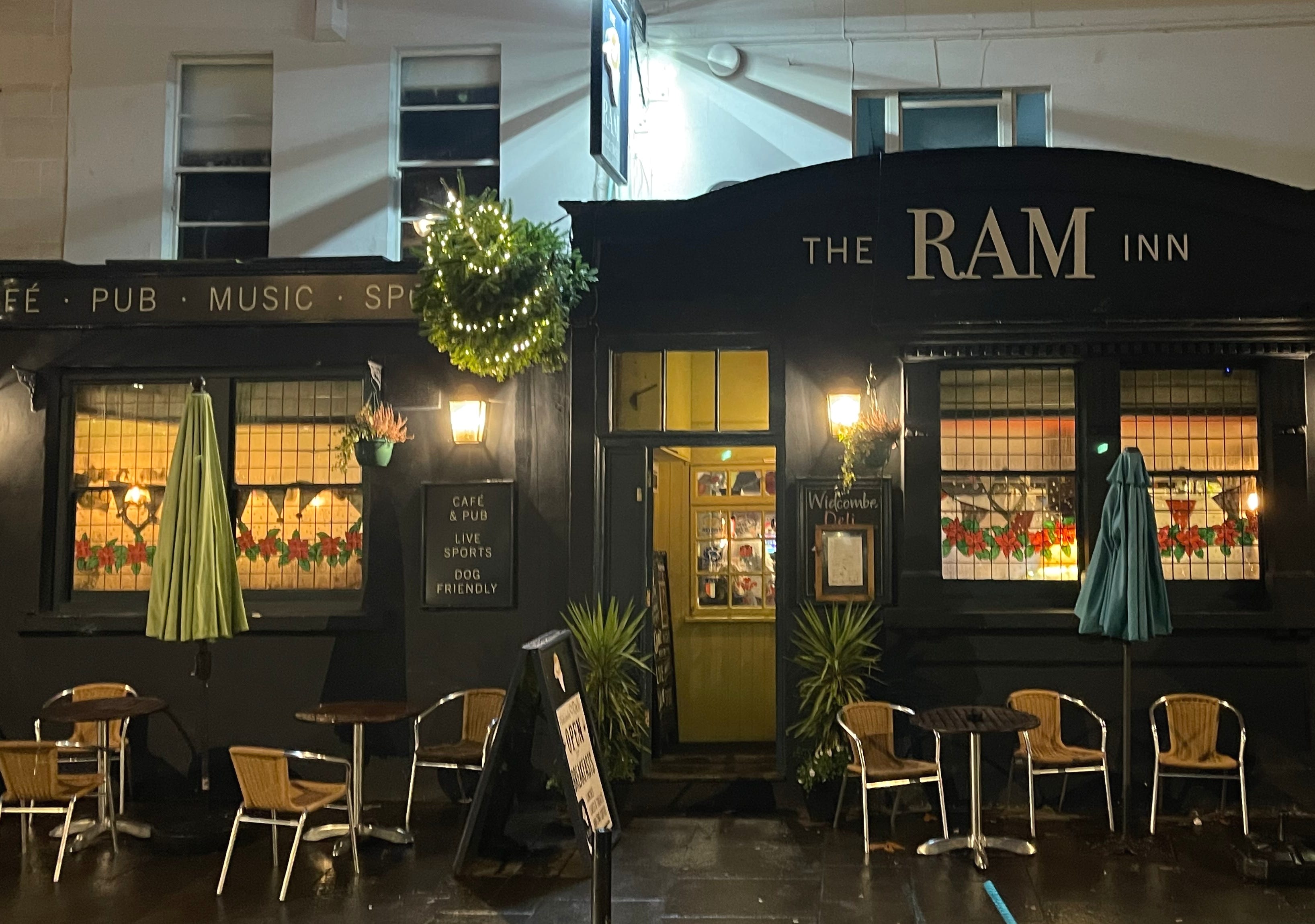
I am writing this in the Ram pub, in Widcombe, just outside Bath. English pubs have evolved during my thirty-four years in America. The Ram serves good coffee all day, and incorporates a deli.
Writing this post has been delayed by a relapse of ME Disease (Chronic Fatigue Syndrome), the subject of my 2012 autobiographical novel, Love and Fatigue in America. For thirty-three years this has been my corrective prompt, repeatedly reminding me that I can plan for the future, but that the future is not mine to know. The unknowable future is the subject of this post
I have been trying to write a novel about how humanity might, in the future, organise itself for the greater good, after being chastened by catastrophes. This is slow to write and likely will have slight effect. The world needs practical solutions here and now. So, here is a simple proposal for the here and now.
A SIMPLE PROPOSAL FOR SAVING THE WORLD (first step)
Invention combined with capitalism has created urgent global problems beyond the reach of national governments, climate change being the most pressing of them. The admirable voluntary targets for reducing carbon emissions brokered by the UN are too weak to succeed, and are already failing.
Proposal:
1. The responsibility for climate agreements should be moved from the UN to the Group of 20. The G20 meetings of Heads of State of the twenty richest and most populous countries of the world has effective global reach (80% of world population, 85% of the economy, 84% of carbon emissions), but is small enough to make big decisions fast. It is potentially powerful enough to make them stick. When the world needed an instant government in 2008 to avoid a catastrophic global financial meltdown, it convened the G20.
2. The OECD should become part of the G20. The G20 is a forum, not an agency; it presently has no secretariat to develop policy or administer decisions. If it is to become effective in addressing the climate emergency, it urgently needs one. Luckily, a potential policy secretariat already exists in the form of the OECD (Organization for Economic Cooperation and Development). The OECD should become the kernel of a G20 secretariat (it already acts as, “strategic advisor”), shifting its focus from serving rich democracies to serving global decision-making.
3. Problem: the G20 is not democratic. The creation of an effective global body to address the climate emergency, and other intractable global problems, will be resisted by those who reasonably fear an undemocratic global tyranny. Also, it will be resisted by powerful nations that fear that their own tyrannies will be diluted. On the latter, as long as nations cannot effectively deal with the problems that threaten the future of humanity, a form of global governance is unavoidably essential. To address the question of democratic accountability as the G20 becomes a governing institution, it should include regional organisations of unrepresented countries (as is already happening), and would need to establish a road map to becoming directly democratic. In this, the EU, which started with a trade agreement between France and Germany and evolved to have direct popular elections across Europe, is an example.
In the short term, for the sake of humanity and all nature, we need a global governing body that can be effective tomorrow in addressing climate change. This is what is available.
WRITING
Imagining the Future
The future is unknowable, but that does not stop us writing about it. I know the near-future I am describing in my novel-in progress will be profoundly wrong even before the book is finished. We’re in an age of discontinuity, when current trends are unreliable guides to the future.
In 2004/5 I was invited by the World Bank to join a multi-disciplinary team that was describing possible Global Future Scenarios just fifteen years’ ahead, that is, 2020. The purpose was not to predict one future but to prepare decision-makers for a variety of possible futures. Many of the examples were prescient, but China has become richer and more powerful than anything imagined, the pervasive influence of global warming was not foreseen, and the ubiquity of social media underestimated. So, if a team of elite World Bank social scientists with all the advantages of the best data can miss big changes just fifteen years ahead, what hope is there for novelists?
But we live in an age of exceptional future anxiety and we can’t stop thinking about it.
Leaving the Room
During a six-month stay in England last winter, I discovered Meetup.com and joined writing groups meeting in cafe’s, pubs and bookshops in London. I was struck first by how much writing was going on, and secondly by how many people were writing speculative fiction set in fully imagined futures.
The writers were well mixed by age and gender, self-actuated, and holding down day jobs. The majority had not yet published a book, but some were published and a few were doing well. They were outsiders to the literary and academic establishments. Generally the standard of writing was high, and the criticisms polite and uncompromising. I thought I might have some special expertise to offer, but I really didn’t.
Among the writers of speculative fiction, the talk was about world-building. I have never written in this genre, and much of this was new to me. The world I have written about is already built and lived in, and I’ve seen the novelist’s job as examining it, and finding value in it. The speculative worlds built were often quite different from the world we currently inhabit, not simply a relevant future mirror for it. It came to seem that these writers had given up the task of considering present life, in favour of leaping to somewhere far away, unconnected, and quite other. It came to seem that these writers were so despairing of the current human experiment that they had simply left the room.
READING
I am saving a discussion of Sally Rooney’s Intermezzo for my next post, which I hope will not be as delayed as this one. Meanwhile, here’s something random from the past, about the present future:
Super-Cannes (2000), by JG Ballard
Recently, I found myself without a new book to read, and trawled my bookshelves for a forgotten one to reconsider. I couldn’t remember much about Super-Cannes so I thought I would read it again. The cover blurb said it was, “The first essential novel of the twenty-first century.” The writing was plot-driven, hectic, and loose. Ballard seemed like a writer in a hurry. It portrayed Cannes as the near-future capital for global tech companies with an international corporate leadership psychologically dependent for their sanity on practicing a culture of violence, racism and sadism that it inflicted on the local population. So, you know, basically wrong.
I met JG Ballard once in London, in the late eighties, around the time he was enjoying celebrity following Spielberg’s film adaption of his autobiographical, Empire of the Sun. My second novel, Written on a Stranger’s Map, had recently been published to little notice. At that time, my life was still mainly running around the world studying remote rural societies in Africa and Asia for UN agencies. I had a PhD in agricultural economics, and was completely outside the London literary scene. I didn’t know a single other writer. I met Ballard entirely by accident in the flat of my ex-pyschotherapist, who was by then my girlfriend. She said that Ballard had become fascinated by her and wanted to base a character on her. I remember him as a gentle man in a tweed jacket who was very thoughtful in conversation until his woman companion intervened to remind me that his opinions were those of a great man, and mine were not. My relationship with my ex-therapist did not last (so chatty), and I wondered if she had in fact become a character in one of Ballard’s novels. I looked for her in Super-Cannes, but the only candidate was a stretch.
Jess Walter has kindly written a blurb for Man Picks Flower:
“Roger King may well have invented the espionage novel of ideas. MAN PICKS FLOWER is at once fast-paced and contemplative, a riveting inquiry into the mysterious power of memory and regret.”
I am grateful to Jess Walter because I had no connection to him and he has been particularly generous in reading my work. Also, I love his take on the book. The number of writers who I greatly admire and who are also #1 NYT bestsellers are very few, but Jess Walter is one. Most recently, I have particularly enjoyed the deep compassion he brings to his characters in the novel, The Cold Millions, and the short stories collection, The Angel of Rome.
Man Picks Flower, will be published in March 2025. If inclined, please do pre-order.